McDonald’s, Fressnapf, Schülerhilfe—they all have one thing in common: They’re franchise companies, just like Coffee-Bike. But not every business model automatically fits every lifestyle. That’s why it makes sense to consider in advance which concept aligns with your vision of self-employment. We’ll show you who’s a good fit as a Coffee-Bike franchise partner and which life situations align well with the Coffee-Bike franchise.
Who Is a Coffee-Bike Franchise Really Worth It For?
24.07.2026 | Self-employment
Why Not Every Franchise Model Fits Every Lifestyle
The idea of starting your own business sounds appealing at first. But there’s often a big gap between the excitement of a franchise model and the reality of day-to-day work. After all, self-employment means something different to everyone.
Imagine three founders: The first person wants to lead a team, manage processes, and run a fixed location with high customer traffic—much like a McDonald’s restaurant. The second person enjoys working closely with people and wants to organize on-site educational programs, similar to a tutoring service. The third person loves variety, wants to be flexible on the go, and enjoy engaging with customers at events—just like with a Coffee-Bike. They all share the same goal: their own self-employment. But the requirements, the day-to-day work, and the personal prerequisites differ significantly. That’s why not every franchise model is a good fit for everyone.
What People Often Underestimate Before Taking the Leap into Self-Employment
Many people interested in starting a business focus on investment costs, revenue potential, and the launch date. What’s often underestimated is the responsibility that comes with running any successful business. Even within a proven system, you remain an independent entrepreneur who must handle organization, customer acquisition, and bookkeeping.
That’s why the crucial question isn’t just, “Do I want to be self-employed?” but rather, “What kind of self-employment is right for me?” The answer to this question often determines whether a franchise concept will be seen as an asset or a burden in the long run. After all, not every form of self-employment feels the same in everyday life.
Why a mobile café has different requirements than a brick-and-mortar location
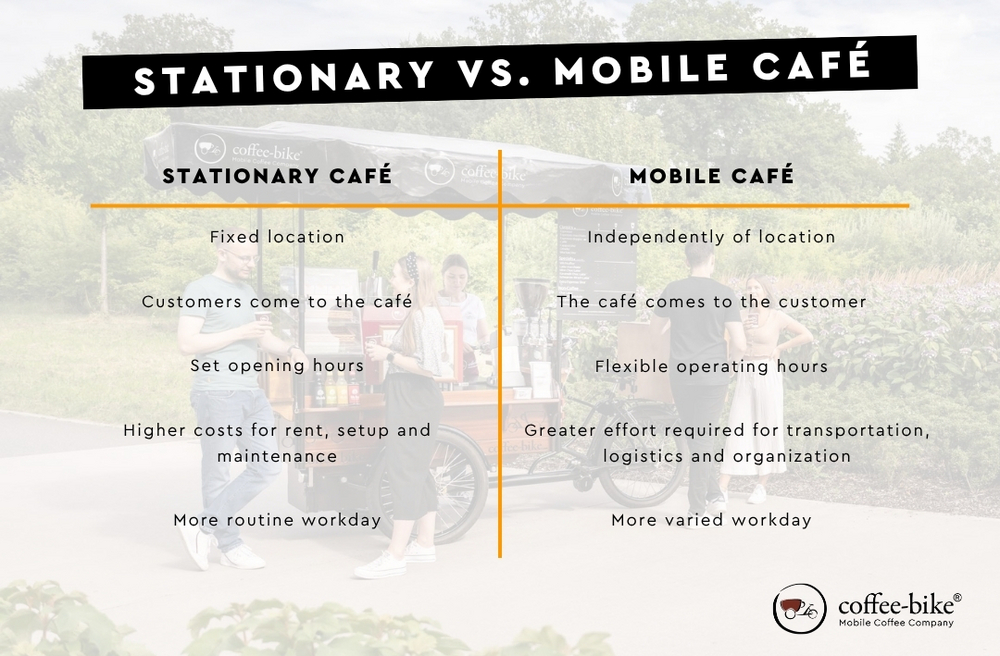
While operators of a brick-and-mortar café unlock the same door every morning, a Coffee-Bike franchise partner is often found where people gather—at corporate events, trade shows, city festivals, or private gatherings. Instead of waiting for customers to come into the shop, the Coffee-Bike brings specialty coffees directly to the customers. A simple coffee-to-go becomes an experiential dining experience.
With a brick-and-mortar location, you’ll also often face long-term lease commitments, high costs for renovations and furnishings, and the need for additional staff. Here, too, you should ask yourself whether you want to focus on securing events or whether you’d prefer to serve your regular customers in one location.
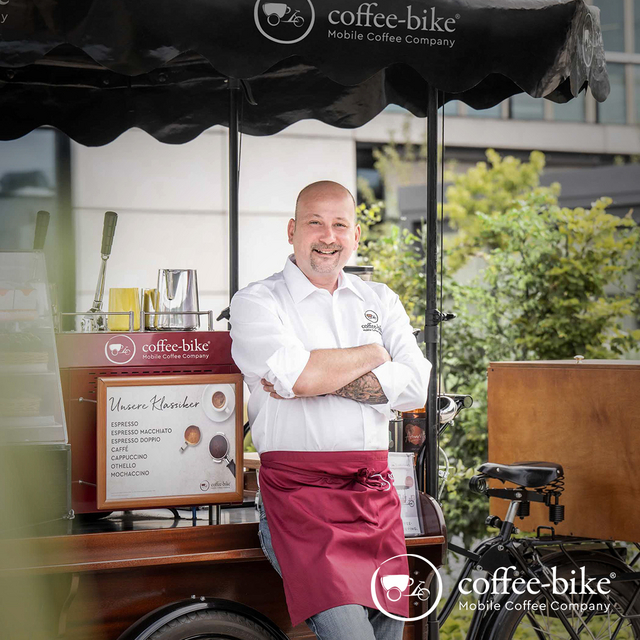
This is exactly where it becomes clear who a Coffee-Bike franchise is suited for: people who value variety, enjoy working independently, and take pleasure in direct interaction with customers. And this works just as well at fixed sales locations as it does for catering and events.
These people are often a particularly good fit for the Coffee-Bike
There’s no such thing as a “perfect” entrepreneur profile! People start their own businesses for a wide variety of reasons and bring their own unique experiences to the table. Nevertheless, experience shows that certain personalities and life situations align particularly well with the mobile concept. The Coffee-Bike combines the freedom of a mobile business with the advantages of an established franchise system. As a result, it appeals to people who think entrepreneurially but don’t want to run a traditional restaurant business with a fixed location.
Anyone wondering who would benefit from a Coffee-Bike franchise should therefore focus less on their past work history and more on their own interests, strengths, and life goals. After all, successful franchise partners come from a wide variety of industries: Some transition from full-time employment to self-employment, while others already have experience in the food service industry. Still others are looking for a way to balance family and work more flexibly or want to start building their own business on a part-time basis at first.
Career changers eager to start their own business
Not every successful entrepreneur has training in the food service industry or has previously run their own business—quite the opposite, in fact.
The Coffee-Bike model can be particularly attractive to career changers because they can rely on a proven concept and the support of a franchise system. Instead of starting from scratch, they benefit from established processes, training, and a well-known brand. Those who have been thinking about starting their own business for some time but haven’t yet found the right business idea often find a relatively straightforward path to self-employment here.
This could be a good fit if…
- you want to be your own boss,
- you come from a different industry,
- you don’t want to come up with your own business idea,
- you’re planning to take the leap into self-employment.
Coffee lovers and baristas who enjoy the product
For some, the passion begins with a good cup of coffee. Anyone who is interested in different types of coffee, enjoys working with high-quality products, and takes pleasure in offering guests a special coffee experience has an important foundation.
It’s not just about making coffee. Many successful coffee bike operators especially appreciate the personal atmosphere on the bike. Unlike in many traditional restaurants and cafes, there’s often direct contact with guests—whether at corporate events, weddings, or at tourist hotspots. If you enjoy striking up conversations and sharing your enthusiasm for coffee with others, this is a great way to combine your passion with entrepreneurship.
This could be a good fit if…
- Coffee is more than just an everyday drink for you,
- you value quality and good service,
- you enjoy interacting with customers,
- you want to sell a product you truly believe in.
Side hustlers who want to test the waters of self-employment
The leap into self-employment doesn’t always have to happen overnight. Many people want to gain some experience first before completely changing their current career path. This is exactly where the Coffee-Bike model can be appealing.
Depending on your personal situation and availability, you can often start by operating a Coffee-Bike at select events or on weekends. This allows aspiring entrepreneurs to gain initial insights, experience customer interaction, and figure out whether self-employment is a good long-term fit for them. For many, running a Coffee-Bike as a side hustle is therefore a way to gain entrepreneurial experience while keeping their personal risk manageable.
This could be a good fit if…
- you want to try out self-employment first,
- you’re still working as an employee,
- you want to grow step by step,
- you want to gain practical experience before making major decisions.
Family-oriented people who want to make the most of flexibility
Many people associate self-employment with the desire for more freedom in shaping their daily lives. Families, in particular, often look for ways to better balance their professional and personal lives.
A mobile business model often offers more flexibility here than concepts with fixed, permanent hours of operation. Events can be planned, assignments coordinated, and work hours partially adapted to personal needs. Of course, a Coffee-Bike is still a business in its own right that requires commitment and planning. Nevertheless, many founders appreciate the opportunity to structure their daily work more flexibly than in traditional salaried positions or brick-and-mortar restaurants.
For many prospective entrepreneurs, the topic Coffee-Bike + Family + Self-Employment is therefore particularly relevant: They aren’t looking for a business that completely dictates their daily routine, but rather one that can be better adapted to the demands of their lives.
This could be a good fit if…
- you value predictable work schedules,
- you want to better balance family and work,
- you want to work flexibly,
- you want to organize your time independently.
What successful Coffee-Bike partners usually have in common
If you take a closer look at the people behind the Coffee-Bikes, you’ll quickly realize: There’s no such thing as a typical resume. Some come from sales, others from the trades, the restaurant industry, or an office job. Some already have entrepreneurial experience when they start, while others are career changers embarking on their first venture into self-employment.
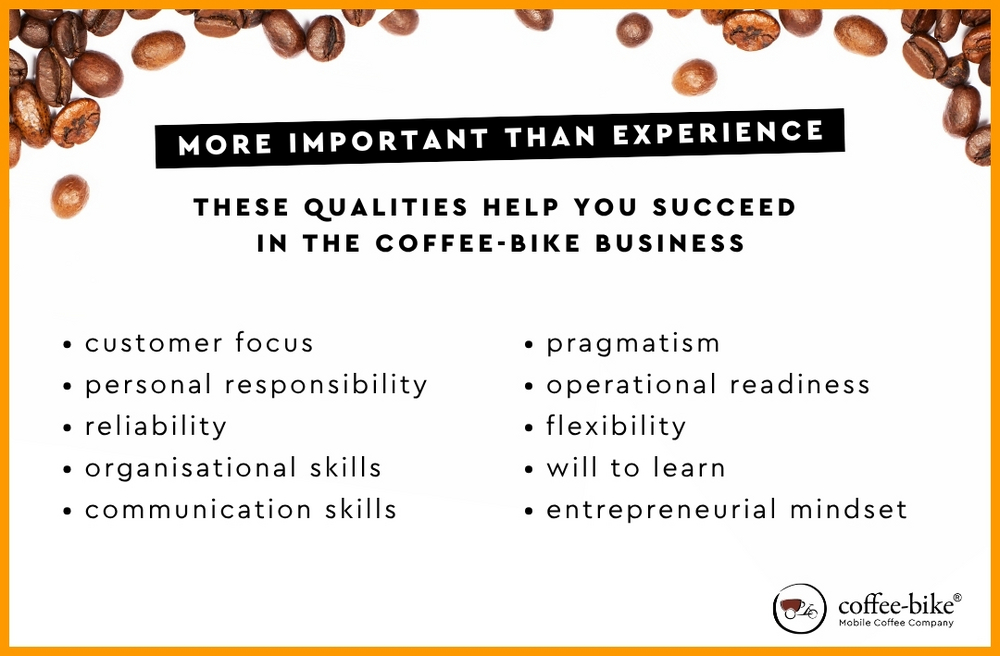
Despite these different backgrounds, commonalities emerge time and again. Success as a franchise partner often doesn’t depend on what profession someone previously held. Much more important are certain personal qualities and the willingness to actively work on your own business.
Enjoyment of Customer Interaction and a Hospitality Mindset
A Coffee-Bike is much more than a mobile coffee bar. It’s often a gathering place, a conversation starter, and a personal experience for guests. That’s why customer interaction and a service-oriented mindset are among the qualities that many successful partners bring to the table.
That said, no one needs to be a natural-born entertainer. What’s far more important is the joy of welcoming people, responding to their requests, and creating a positive atmosphere. A friendly conversation while preparing coffee or a warm smile can leave just as big an impression as the quality of the coffee itself.
Many typical Coffee-Bike franchise partners therefore see themselves not only as entrepreneurs but also as hosts. They enjoy bringing people together and enriching events with their offerings.
Personal Responsibility, Pragmatism, and Dedication
Even though the Coffee-Bike is backed by a proven franchise system, success remains closely tied to personal commitment. Preparing for events, coordinating assignments, serving customers, or solving unexpected challenges—all of this is part of a franchise partner’s daily routine.
That’s why people who can act independently and make decisions on their own benefit the most. At the same time, a pragmatic approach is helpful. Not every situation goes exactly according to plan, especially during field assignments or events. Those who think flexibly and act in a solution-oriented manner usually find a way to overcome challenges quickly.
Equally important is the willingness to roll up your sleeves and get involved. The Coffee-Bike is not a business model that’s managed exclusively from a desk. Successful partners combine entrepreneurial thinking with hands-on work while keeping their focus on what matters most.
Openness to Planning, Business Development, and Growth
Good coffee alone isn’t enough to build a successful business. If you want to grow over the long term, you’ll also need to focus on areas such as customer acquisition, scheduling, and the ongoing development of your own business.
Many successful Coffee-Bike partners therefore view their business not as a rigid concept, but as an ongoing learning process. They leverage new contacts, build on existing customer relationships, and keep an eye out for additional opportunities in the market.
This doesn’t require a natural sales personality. Often, all it takes is a willingness to actively reach out to people, build networks, and raise awareness of your own offerings. Those who remain open to new ideas and develop their business step by step create the right conditions for sustainable success.

Who This Model Might Not Be Ideal For
The question “Who is a Coffee-Bike franchise suitable for?” is often easier to answer when you also consider the other side of the coin. If you want to be satisfied in the long run, you should always ask yourself whether the model fits you, your expectations, and your lifestyle and work style.
Let’s take a realistic look at the Coffee-Bike franchise together: While a Coffee-Bike offers a lot of freedom, it’s not self-employment on autopilot. If you prefer to spend most of your workday at a desk or run a business as passively as possible, you’ll likely feel less comfortable with the Coffee-Bike model. That’s because success is based on personal commitment, customer interaction, and hands-on involvement.
If you’re expecting maximum passivity or purely desk-based work
A Coffee-Bike is not an investment that can be managed entirely on the side. Interacting with customers, preparing for assignments, and being present at events are integral parts of the business model. Anyone who primarily wants a desk job or is looking for a source of income that requires as little active involvement as possible will likely struggle with the day-to-day work of a mobile café.
At the same time, planning, organization, and business management tasks are, of course, part of everyday business operations. The difference from many other business models is that the work does not take place exclusively behind a screen. Anyone who enjoys direct contact with people and likes to be actively involved in the action will therefore often feel more at ease than someone who wants as little external contact as possible.
When flexibility is desired, but not operational responsibility
For many, the flexibility to shape their daily work routine is a major advantage of this model. At the same time, this freedom requires that assignments be planned, clients be supported, and organizational tasks be handled reliably. Anyone seeking only the freedoms of self-employment without taking on operational responsibility will likely struggle with this concept.
To summarize: The Coffee-Bike model is probably not ideal if…
- you’re looking for a source of income that’s as passive as possible.
- you want to work exclusively at a desk.
- you don’t particularly enjoy direct customer contact.
- you want to avoid operational tasks as much as possible.
- you want flexibility but don’t want to take on entrepreneurial responsibility.
Self-Employment, Free Time, and Family—How Realistic Is the Balance?
Often, the decision to become self-employed is influenced not only by the business concept but also by the question of how well one’s own business can be balanced with family, free time, and personal commitments. Especially those interested in topics such as Coffee-Bike family self-employment or Coffee-Bike self-employment free time typically want more flexibility in their daily lives than they would have in a traditional employment relationship.
In fact, the Coffee-Bike model can offer interesting opportunities in this regard. At the same time, it would be too simplistic to automatically equate self-employment with more free time. After all, even a flexible business model requires planning, reliability, and personal commitment. The difference often lies less in the amount of work and more in the ability to manage one’s own time more actively.
The Role of Scheduling and the Business Model
The balance between self-employment and personal life is significantly influenced by scheduling. This is precisely where one of the differences from many traditional restaurant concepts lies. Instead of operating from a fixed location at set times every day, the Coffee-Bike often operates based on booked events or corporate assignments.
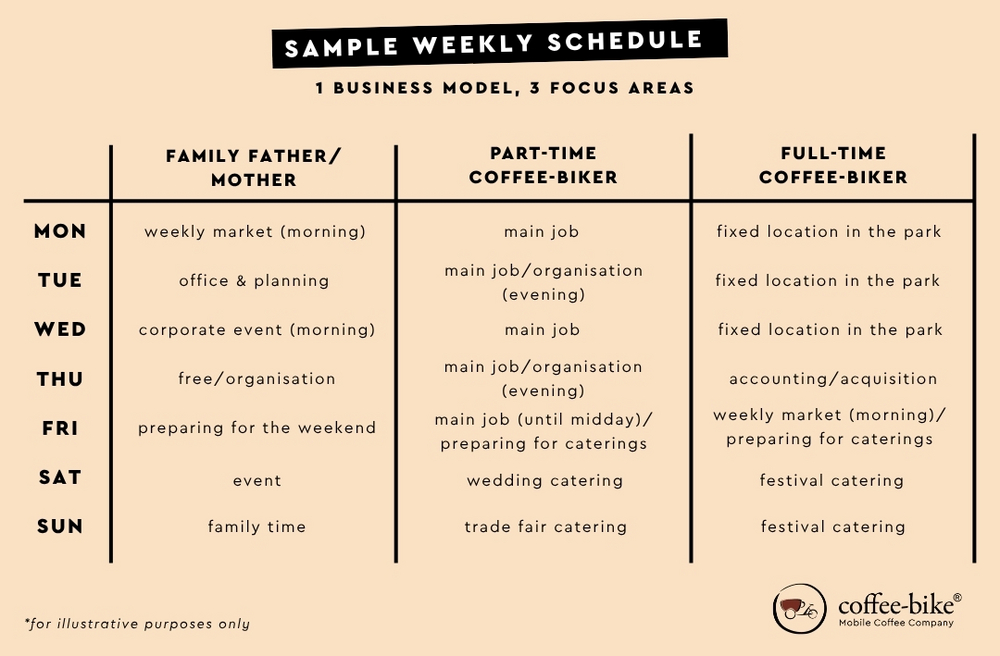
This can result in very different weekly schedules:
Scenario 1: A father sets up his Coffee-Bike at a farmers’ market twice a week in the morning while his children are at school. He secured a large trade show catering gig for the weekend months ago and was thus able to plan his family responsibilities accordingly.
Scenario 2: A couple with two children runs the Coffee-Bike together. While one person handles bookings, invoices, and customer communication, the other takes care of on-site assignments. By dividing the tasks, both can organize their work schedules flexibly and adapt the business to their family situation.
Scenario 3: A former sales representative has started her own business after many years as an employee. During the week, she primarily handles corporate events and employee gatherings. Since
many of these events are planned well in advance, she can factor in personal commitments and vacation time early on.
However, this flexibility does not mean that they work less. Rather, it creates the opportunity to better tailor their work hours to their personal circumstances. For parents, for example, this can be helpful in consciously setting aside specific times for family. Others use this flexibility to better integrate hobbies, volunteer work, or personal projects into their daily lives.
Why Flexibility Doesn’t Automatically Mean Less Responsibility
A common misconception is to equate flexibility with less effort. In fact, these are two different things. A simple example: If a customer event has been confirmed for a specific day, this creates a binding obligation—regardless of how flexible the business model is in general. This is precisely why many successful franchise partners rely on good planning and clear priorities.
Freedom, then, does not lie in spontaneously working fewer hours at any given time, but in being able to actively shape one’s own daily work routine. For many entrepreneurs, that is precisely the key advantage. They do not necessarily want to take on less responsibility, but rather to decide for themselves how to balance work, family, and leisure time.
Typical Success Profiles in the Coffee-Bike Franchise
The Coffee-Bike family is just like any other family: many different people who share a common bond. In our case: the Coffee-Bike and its delicious coffee specialties. Everyone brings different experiences to the table, has their own personal background, and pursues individual goals.
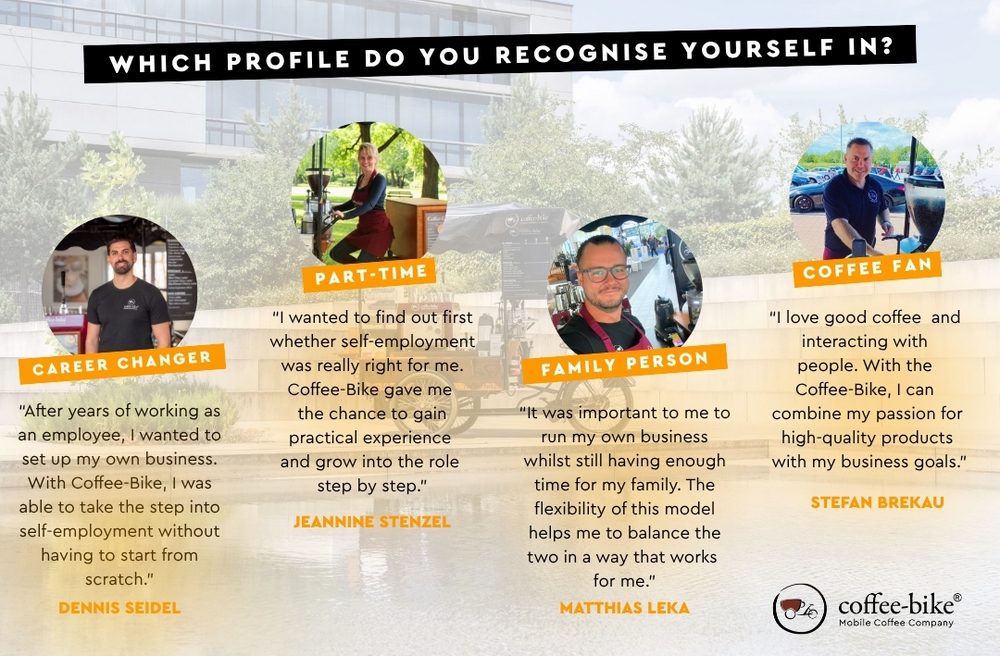
Whether male or female, young or old, with or without experience in the food service industry—every Coffee-Bike franchisee can make their own business a success. There’s no single “perfect” Coffee-Bike franchise partner, because these profiles aren’t rigid categories. Rather, they highlight typical characteristics and life situations that align well with the franchise concept. You might even recognize yourself in several of them.
The Career Changer
The career changer has often already gained several years of professional experience and feels the desire to build something of their own. They want to be an entrepreneur without having to develop a business idea from scratch. They often bring experience from fields such as sales, skilled trades, administration, or the service industry. What sets them apart is their pragmatism, willingness to learn, and desire to take responsibility for their own success. They view the fact that they don’t come from the restaurant industry less as an obstacle and more as a new challenge.
The Side Hustler
The part-timer wants to approach the transition to self-employment cautiously at first. Instead of putting all his eggs in one basket right away, he gains practical experience and tests whether entrepreneurship aligns with his personal goals. Typical work involves shifts on weekends or at select events. This allows them to attract their first customers, familiarize themselves with operational processes, and build their business step by step. For many successful franchise partners, this very path was a key stepping stone into self-employment.
The Family-Oriented Person
For the family-oriented person, business success isn’t the only focus. Just as important is the question of how to balance work and personal life. They value the ability to plan appointments well in advance and consciously adjust their work hours to fit family needs. Whether it’s school breaks, childcare schedules, or family time together—the flexibility of this model can help make daily life more personalized. At the same time, they are aware that self-employment also requires responsibility and good organization.
The Connoisseur with an Entrepreneurial Spirit
This profile combines a passion for good coffee with the desire to run one’s own business. The connoisseur is interested in high-quality products, values quality, and takes pleasure in offering guests a special experience. At the same time, he thinks like an entrepreneur. He wants to attract customers, expand his network, and further develop his business . For them, coffee is not just a product, but also a conversation starter and a calling card. It is precisely this combination of enthusiasm for indulgence and entrepreneurial thinking that you find in many successful Coffee-Bike franchise partners.
Learn More About the Coffee-Bike Franchise
If you recognize yourself in one of the profiles presented, it’s worth taking a closer look at the franchise concept behind Coffee-Bike. After all, the best way to determine whether the model is right for you is to understand both the day-to-day requirements and the general terms of a partnership.
Learn About the Franchise Concept
To get an overview of the benefits of the franchise system , check out the information on our website. Whether you’re a career changer or looking to start part-time —the opportunities at Coffee-Bike are diverse.
More Information on Getting Started and General Conditions
If you’d like to learn more about the model, you’ll find additional information on the requirements, terms and conditions, and the most important questions regarding a franchise partnership with Coffee-Bike. We’d love to discuss your vision and how your personal path into the business might look.
These articles might intrest you:

Coffee-Bike Amazing Places #9: A location with a promising future – a Dresden Coffee-Biker reports
08.06.2021 Read article