

Self-employed on a part-time basis – find out more at Coffee-Bike!
The path to self-employment is appealing to many people who want to fulfil their dream of running their own business and pursue their passion with flexibility. But not everyone wants to take on the full risk straight away. This is exactly where part-time self-employment comes in – a model that combines security with entrepreneurial freedom.
Coffee-Bike is a mobile concept that offers a gentle introduction to running your own business, whether as a full-time Coffee-Biker or as a part-time self-employed person.
Can you be self-employed on a part-time basis? Here’s what you need to know first
Is it even possible to run your own business alongside a full-time job? The answer is: yes. And for many people, it’s actually the most sensible and realistic route to starting their own business. But before you get started, there are a few basic things you need to understand in order to plan your business.
Before you start, you should be aware that even a side business requires planning and discipline. Your self-employment must be compatible with your main job, and you should allow sufficient time for organisation, clients and processes. You must also take into account the formalities such as registration, taxes and, where applicable, insurance.
Important: Legally speaking, a side business is also considered genuine self-employment. This means you must officially register your business – either as a trade or as a freelance activity, depending on the nature of your business.
Why a Coffee-Bike can be a great way to start out in part-time self-employment
A mobile coffee bar is a good example of a concept that is particularly well-suited to those starting out in part-time self-employment. It combines flexibility with a clear business idea and manageable risk. Coffee-Bike is a tried-and-tested franchise system with over 15 years’ experience and a brand that is already well-established in the market.
You remain in full-time employment whilst also running your own part-time business. You run your mobile café out of a passion for coffee. Whether you simply want to try out self-employment for now, or you only wish to be self-employed part-time due to time constraints.
Working hours, income limit and scope of work
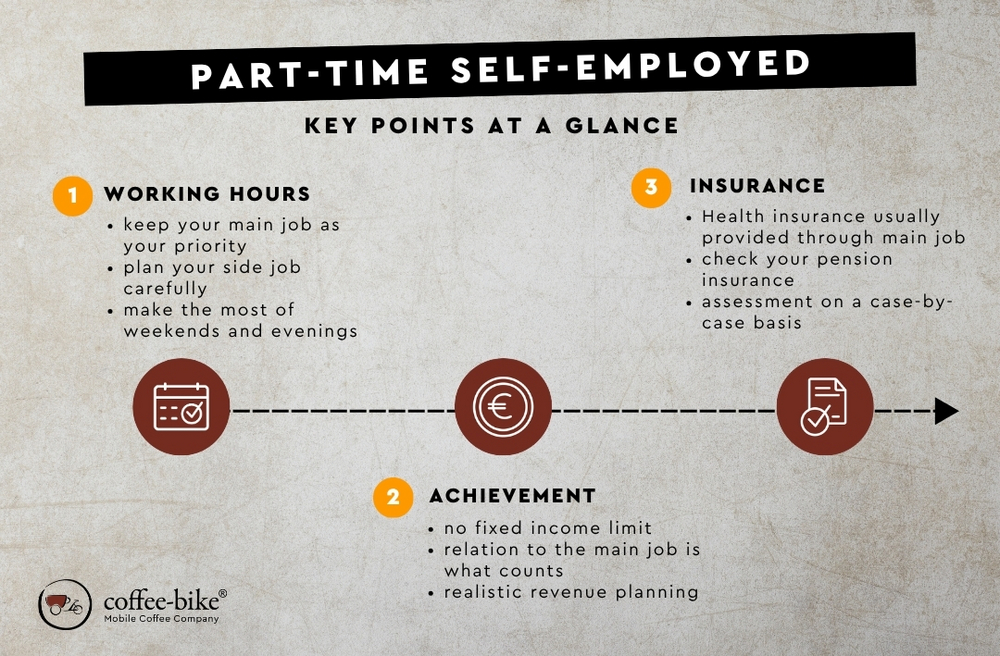
It is often assumed that there is a fixed income limit for part-time self-employment. In reality, however, there is no rigid limit. Instead, the overall picture is always taken into account.
As a guideline: you are considered to be in part-time self-employment if you work fewer than 20 hours per week and regularly earn less than you do in your main job. It is therefore assumed that your main job remains the focus of your professional activity.
If you consistently generate more profit (i.e. income minus expenses) from your secondary job and also invest more time in it, the classification may change, which is particularly important in terms of tax regulations.
An overview of health insurance, pension insurance and social security
As well as the tax framework, insurance plays a major role. In many cases, you will continue to be covered by your employer’s health and social security schemes as long as your self-employment remains strictly part-time. This means that, as a rule, you will not have to pay any additional contributions towards health, long-term care or pension insurance.
Important: There are no one-size-fits-all answers here. It depends on your individual situation. That is why it is advisable to look into health insurance, pension insurance and social security in advance and assess your specific circumstances. Your health insurance provider, for example, can help you with this.
Note: This article is intended solely as a guide for those interested and does not constitute legal or tax advice.
What you should sort out before you start
To ensure a smooth start, you should sort out a few basic matters in advance. This involves not only reviewing your employment contract, but it’s usually a good idea to inform your employer of your plans as well.
Good preparation ensures that you can focus fully on your business later on.
Checklist
- Check your employment contract – Are there any guidelines or restrictions on secondary employment?
- Inform your employer – Is consent required?
- Realistically assess your time availability – Does self-employment fit into your daily routine?
- Assess your business idea – Is there a demand for it and is it feasible to implement?
- Clarify business registration requirements – Does your activity require registration?
- Understand the basics of taxation – Income, expenses, bookkeeping, and the small business scheme where applicable
- Check health and social insurance – Will your cover remain in place?
- Consider pension insurance – Is insurance compulsory?
- Plan costs and budget – What investments are needed?
- Define your goals – Extra income or a long-term prospect?
Part-time self-employment ideas – which models are actually viable?
There is a wide range of business ideas to choose from. However, when running a side business alongside your main job, it quickly becomes clear which concepts can actually be put into practice in everyday life and which are less likely to work.
Setting up your own business as a side hustle not only involves less risk but also offers the chance to turn your passions into income. That’s why there are no limits to your creativity when choosing your side hustle.
Common ideas for side jobs
Classic ideas include activities such as freelancing in the creative sector, setting up an online business, or offering craft-based services. Many people also find small-scale catering concepts appealing at first glance.
In the ‘do-it-yourself’ sector, some small business owners sell their own designs via an online shop or on request. Others work as consultants and offer online courses or coaching in areas such as fitness, nutrition, careers or finance.
Part-time self-employment in the social media world as a so-called ‘influencer’ is also very much in vogue. Those who prefer to be behind the camera can set themselves up as photographers or videographers.
But local services such as dog-sitting, everyday help with the home and garden, or renting out rooms via Airbnb are also notable examples.
Which models are actually feasible in everyday life
In practice, however, it often turns out that many of these models require more time than anticipated. Client acquisition, organisation, bookkeeping and day-to-day operations quickly add up to a considerable workload.
This can quickly become a challenge, particularly when juggling a full-time job. Often, it’s difficult to plan ahead, or the work is hard to scale.
Creative work such as content creation or design services is still among the easiest to implement, as these tasks can be done easily from home. Whereas with a side job in the trades or local services, you are always dependent on other people.
Why a Coffee-Bike can be a great way to start out in part-time self-employment
A mobile coffee bar is a good example of a concept that is particularly well-suited to those starting out in part-time self-employment. It combines flexibility with a clear business idea and manageable risk. Coffee-Bike is a tried-and-tested franchise system with over 15 years’ experience and a brand that is already well-established in the market.
You remain in full-time employment whilst also running your own part-time business. You run your mobile café out of a passion for coffee. Whether you simply want to try out self-employment for now, or you only wish to be self-employed part-time due to time constraints.
Get started flexibly without a traditional shop
Unlike a brick-and-mortar café, with a Coffee-Bike you don’t have to pay expensive shop rent, you can avoid staff costs, and you can launch your business with lower fixed costs.
You can run your business on the go and choose between different sources of income: a fixed sales location, pop-up sales at events, or booked coffee catering. A combination is, of course, also possible. Here, too, you need to find the right model for your daily life to integrate part-time self-employment.
Schedulable shifts alongside your main job
As your mobile coffee bar offers a range of ways to generate revenue, you can tailor your shifts to fit your daily routine. If you run a mobile café as a side business, it’s often difficult to operate from a fixed location. This is because such venues sometimes have regulations and opening hours that could limit your flexibility. What might suit you would be independent sales at, for example, weekend markets.
As a part-time coffee biker, however, events and catering are likely to be your main sources of income, as you can plan these assignments well in advance and coordinate them with your main job. This allows you to take on catering jobs at weekends, such as weddings, birthday parties or trade fairs. You can also specifically apply for pop-up stalls at festivals, for example, if you’re currently on holiday from your main job.
You’re in control of the assignments you’d like to take on and can fill your diary with bookings according to your own preferences.

Less risk, more practical experience
A Coffee-Bike allows you to gain practical experience and start your business with less risk. You’ll learn how to deal with customers, develop a feel for the market and can continuously improve your offering. At the same time, you retain the security of your main job.
Whether you start with Coffee-Bike on a full-time or part-time basis, the onboarding process is the same. We invite all franchise partners to a barista and technical training course at the Coffee-Bike Academy, provide tips on customer acquisition and supply marketing materials. Your personal contact is also available at any time to answer your questions.
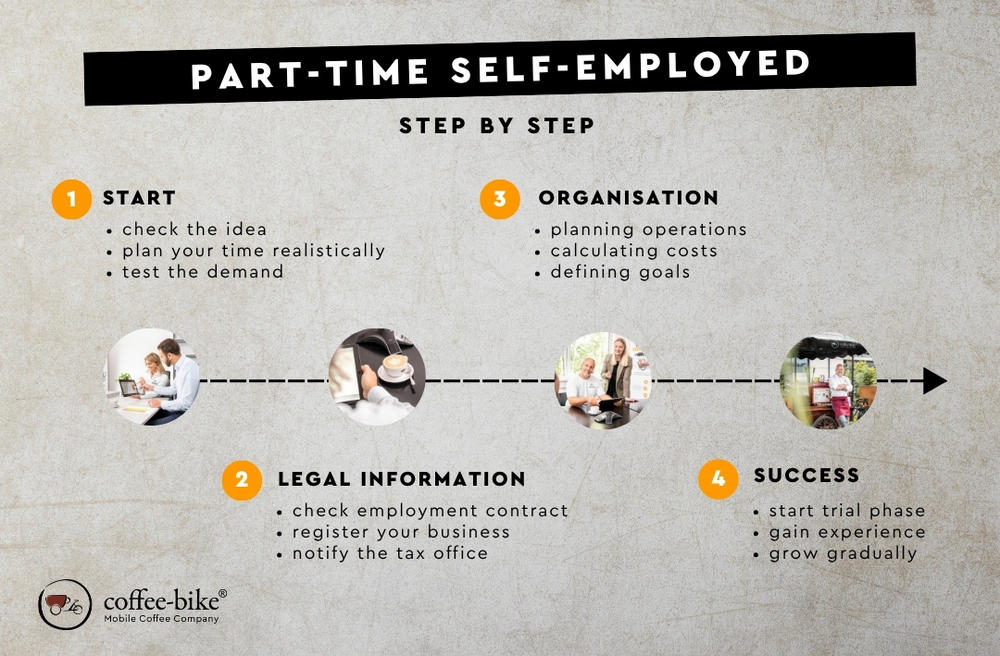
Step by step: Starting a side business
Launching a side business doesn’t have to be a complicated process. With the right approach, you can get started in a structured and confident way. We’ll show you the steps involved.

Assess your idea and clarify the framework conditions
To begin with, you should always ask yourself: Does the idea of becoming self-employed on a part-time basis fit in with your life? Be honest with yourself about how much time you can invest alongside your main job without other areas of your life suffering.
Equally important is the demand for your service. Are there potential customers, and is your concept realistic to implement? Especially when working part-time, you should ensure that your plans are easy to manage.
The framework conditions also play a role: what costs are involved, what registrations are required, and how flexible can your project be? If you clarify these points early on, you’ll lay a solid foundation for your start.
Business Registration, Tax Office & Legal Form
In most cases, you will need to register your business as soon as your activities are aimed at making a profit. In Germany, this is usually a straightforward process handled by the relevant trade office. By registering, you lay the foundations for your self-employed work and officially receive permission to run your business.
What does the business registration process actually involve?
- Registration with the relevant trade office (often possible online)
- Costs usually between 20 and 60 euros
- You will receive a business licence as official confirmation
- Automatic notification to the tax office and, where applicable, other authorities
The next step is to register with the tax office. There, you will complete the so-called ‘tax registration questionnaire’, detailing the nature of your business and establishing key details. You will also receive your tax number, which you will need for invoices and tax-related matters.
As far as the legal form is concerned, many part-time self-employed people start out as sole traders. This form is particularly straightforward and can be set up without much red tape. Especially when starting out in a part-time capacity, this is a practical solution that allows you to get started quickly and flexibly.
Focus on the small business scheme
The small business scheme is a particularly popular option for those working on a part-time basis, as it makes getting started much easier.
The small business scheme is particularly suitable if you:
- expect to generate only a small amount of turnover
- are just testing the waters of self-employment
- want to keep administrative burdens to a minimum
One advantage is that you do not have to show VAT on your invoices or submit regular VAT returns. This saves time and makes your bookkeeping much simpler, which is an important factor if you are building up your self-employment alongside a main job. Note, however, that in return you cannot deduct input VAT on investments (e.g. equipment). Especially at the start, you should therefore weigh up what makes more sense for your business model.
At the same time, you can focus more on your actual business: attracting customers, improving processes and optimising your offering. This is a major advantage, particularly during the testing phase of your idea, as you don’t have to invest your energy in complex tax issues.
However, it is important to keep the requirements in mind. The small business scheme is subject to certain turnover limits and should be used deliberately as a strategic decision. For many part-time self-employed people, however, it is an ideal way to start self-employment in a straightforward manner and with little effort.
From a side hustle to a real opportunity
Many successful self-employed people before you started out exactly the same way: small, part-time and with manageable risk. A side hustle gives you the chance to test your idea without too much pressure, attract your first customers and get a feel for the market. You can gain experience, streamline processes and, step by step, figure out what works and what doesn’t.
Over time, this often develops into more than just extra income. If your business model proves successful, it can develop into a stable second source of income, opening up greater financial independence and new opportunities. Some choose to remain in a side hustle, whilst others use this path as a springboard to full self-employment.
The key is to take that first step and stick with it. Growth rarely happens overnight; it comes about through continuous development. If you build your self-employment strategically and learn from your experiences, a small side project can develop into a real career prospect in the long term.
Your path to part-time self-employment – find out more now
If you’re thinking about starting a part-time self-employed business, now is the right time to take a closer look at your options. Do some research online and offline to see what kind of part-time self-employment you could envisage, and start comparing your options.


Find out more about the franchise concept
A franchise model like Coffee-Bike offers you the advantage of being able to rely on a tried-and-tested system. You benefit from existing expertise, clear processes and support during the set-up phase. This significantly reduces the typical risks associated with starting a business. Find out more about the Coffee-Bike franchise on our website.

Find out more about getting started with Coffee-Bike
If you’re looking for a flexible, tried-and-tested concept that’s easy to run as a side business, it’s worth taking a closer look at the Coffee-Bike. It could be the first step towards your future as an entrepreneur.
Start your own part-time business with Coffee-Bike: Find out more now!
FAQ on self-employment as a part-time job
You probably have lots of questions about self-employment, particularly about running a side business. Below, we’ve summarised a few answers for you:
1. Can you be self-employed on a part-time basis?
Yes, part-time self-employment is generally possible and quite common, provided it does not take precedence over your main job.
2. When are you considered to be self-employed on a part-time basis?
When your main job takes up the majority of your time and provides the bulk of your income, and the self-employed activity is carried out on a supplementary basis.
3. How long can you remain a ‘part-time self-employed person’?
As long as the self-employed activity does not form the main focus of your professional life.
4. What is the easiest way to start working part-time as a self-employed person?
The easiest way is to start with a clear business idea, plan your time realistically and sort out the necessary formalities early on. Many people start small and build their business up step by step.
5. How much can I earn as a part-time self-employed person?
There is no fixed limit. The key factor is the ratio to your main income.
6. How many hours can I work as a part-time self-employed person?
Again, there is no fixed limit. The important thing is that your main job remains the focus.
7. Do I have to inform my employer if I am self-employed on a part-time basis?
In many cases, yes – particularly if your employment contract contains relevant provisions.
8. Do I remain covered by health insurance?
As a rule, you remain insured through your main job as long as your self-employment remains part-time.
9. What do I need to bear in mind regarding pension and social security contributions?
That depends on your line of work. In some cases, there are specific insurance requirements.
10. Can I be self-employed or a small business owner in a part-time role?
Yes, the small business scheme is a frequently used and sensible option, particularly for those starting out in a part-time capacity.
11. Do I need to register a business?
Usually, yes. If you work regularly with the intention of making a profit, you must register a business. Exceptions include freelance work.
12. Can I switch from part-time to full-time self-employment later on?
Yes, many people switch from part-time to full-time self-employment. The prerequisite is that your business is stable enough and generates regular income.